Every game becomes SQL tables
Each replay is played back through the official engine and written into tables, so a question about a thousand games is one query.
What each turn’s rows record
- intentwhat each body meant to do
- executioncalls the engine refused
- stallsruns of turns with no progress
- seeswhat each body could see
A tool for each blind spot
I never read the bot’s code. I watched games and read the agents’ explanations, and each time an explanation fell short I had a tool built, often the same night.
- “Way, way, way too slow”A study of 80 games was too slow. I asked for one command under a second for a thousand. The SQL tables landed at 01:30.
- “Why doesn't the trace explain it?”Only a temporary print had found why a body stood still. Agents built a per-body explanation and a replay with any build's prints.
- “One general tooling”I wanted one tool bent with SQL, not a new one every two hours. Agents added a fork: replay a game exactly up to any round, then play live from there.
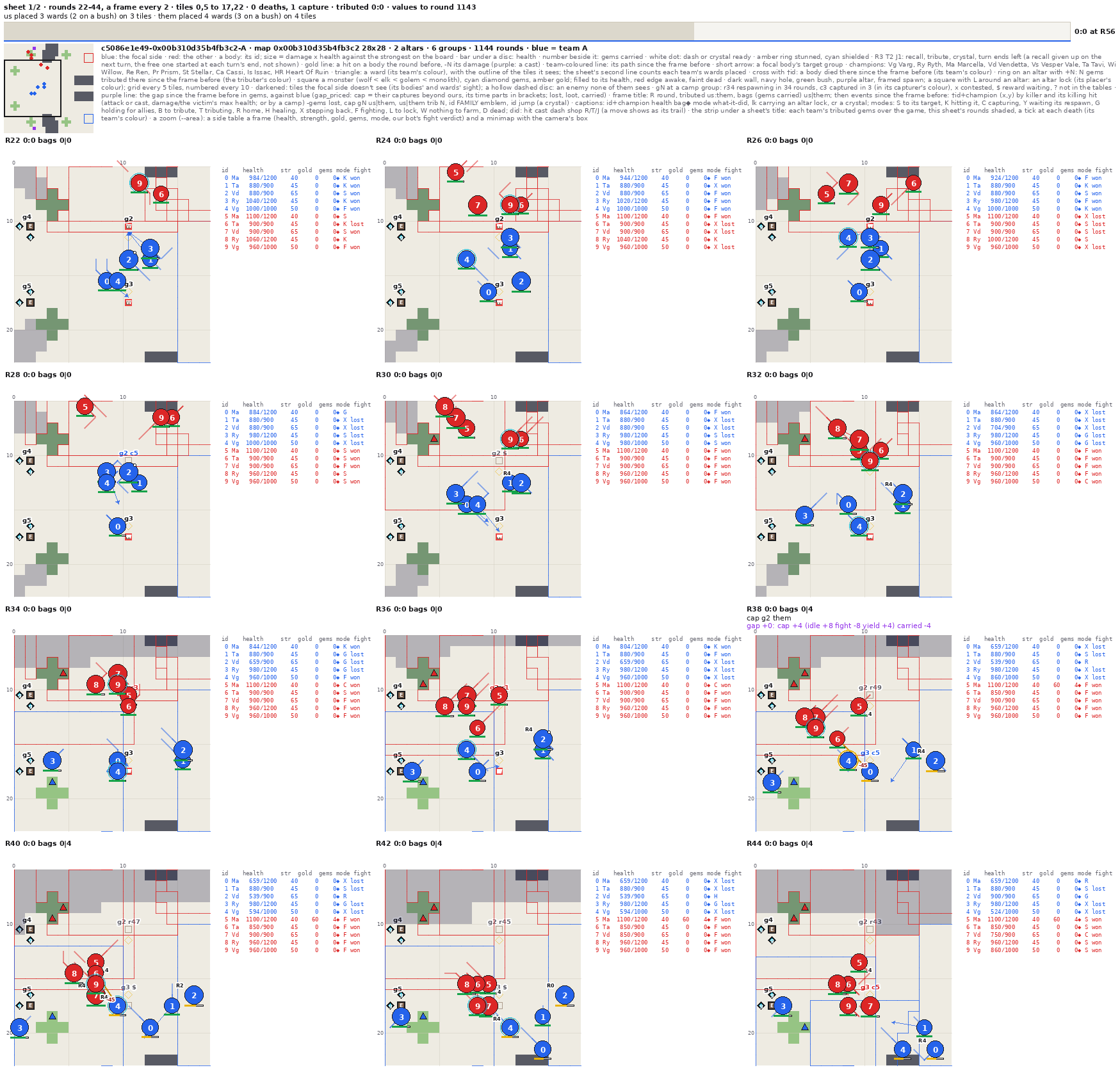
- “Pretty easy to spot with the visual view”I had seen wards dropped against a wall. By 02:12 agents had image sheets: the whole map, a frame every 10 rounds.
- “Causality and consequence”A tool I asked for on 8 Nov to price a fix before making it ranked consequences, not causes. Rebuilt, it split the gems gap to the top teams into causes in under a second.
- Stories for tracersA command told a lost game as a story, in place of the SQL each tracer typed by hand.
Probe a replay, fork it from any round
A probe replays a game byte for byte with any build’s prints. A fork replays it up to a chosen round, then lets a changed bot play on from there.
What each tool caught
| What agents saw | Tool | What it was |
|---|---|---|
| A Tavi stood still for 134 rounds | a temporary print | 32k fuel left against a 43.7k guard, so it fell back to a straight step that never advanced |
| A Vendetta looping for 307 rounds | a replay with a probe build's prints | explained in one command |
| Hurt bodies dying out of sight | a fork from a round | the trip home priced one turn's risk over the whole walk: deaths in 54% of lost games, 19% of won ones |
| Wards refused again and again | scenarios on the official engine | an ally's hidden ward: 9,675 repeats in 242 games |
What an agent looks at
An image sheet is a game drawn for a model to read: the whole map, a frame every few rounds, every body numbered, and beside each frame a table of health, gold, gems and what each body was doing.
One frame, up close
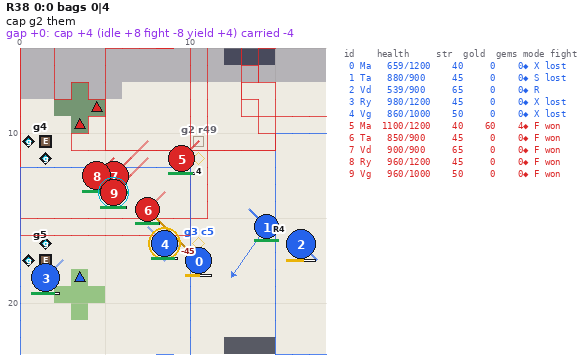
Image sheets against tables, in a blind test
- Test 1, sheets onlyL: four deaths placed wrong, ward counts backwards
- Test 1, tables onlyW: everything right
- Test 2, sheets fixedW: every death placed right
Mechanics settled on the real engine
When the written rules left a question open, an agent wrote a small scenario and played it on the official engine. The answer went into one file of engine facts, each with its scenario.
- The written rules
- A readable port of the engine, deleted 6 Nov
- A scenario on the official engine
The file of engine facts
# Mechanics the rules leave open
…
- A dead camp's tile is walked while its group lives, refused only onto an ally
(dead-camp-tile.json), and a tribute from such a tile beside an altar
completes (ringed-altar.json).
- A capture's timer starts over the moment its tiles stand empty, within a round …
(capture-one-tile.json) … So a group of two or more tiles is handed over
and a one-tile group is not.
| Question | What the official engine showed |
|---|---|
| Does a dead camp keep its tile? | no: its tile can be walked while the group lives |
| Are altar-lock refusals a bug? | no, they were the lock working: “fixing” them cut wins against v5 from 95.8% to 43.5% |
| Does the Tribute emblem shrink the bag? | no, it shortens the channel: a bag of 30 or fewer takes as long with it |
| How far does a teleport crystal reach? | 3 tiles, over two walls or two holes; 4 is refused |
What I spotted by watching
Some faults only show on screen. I watched games, wrote down what looked wrong and handed each to its own agent.
| What I saw | What it was | Result |
|---|---|---|
| Champions idle at spawn | start-up fuel: the first move came at round 2.85 on average, then 1.54 | kept, +1.06 |
| A Varg recalling 2 tiles from spawn | a recall kept where walking was faster | kept |
| Wards placed non-stop, replacing the last | wards that never showed a new tile | a rule for every agent: no action whose effect is void |
Wasted wards
- Claudus Maximus
- Opponents
Studying the field
Agents mined public replays, played scrims against chosen teams and, from 8 Nov, kept an archive of the field’s public games.
What the scrim queue played
- 7 Novthe three highest-rated teams
- 9 Novthe 20 teams rated nearest us
- 10 Novthe finalists
v50’s win rate on 1 Nov, from 1,190 games
Fish was the hardest: it drafted Cassi & Issac in 85% of games. On three-champion maps, v50 won 74 of 158 games without the pair in Fish’s draft and 3 of 35 with it.
News reached agents only through my laptop
Staff posted rules and dates on Discord, which agents could not read. A job on my laptop pushed what my Discord app had cached into the first repo.
- First exportI scrolled the channels so my app cached them: 3,169 messages from 6 channels.
- AutomaticA laptop job pushed new messages within about 75 minutes of my app showing them.
- Feed stopsThe job was deleted with the first repo, at 5,108 messages. Nothing replaced it.
- The finals lock is announced13 Nov, 23:59. The agents on the server still planned for 17 Nov.
- Found in the cacheI let my laptop agent read the cache. It found the date in a minute.
- CorrectedI fixed the date in the server's records.
The lesson was the same as for games: what agents cannot read does not exist for them.